// wordpress · ai
Every few months a new headline appears: “WordPress is dying” or “AI will kill ready-made websites.” I build and run WordPress sites for the Saudi market and use AI every day to manage them, so I wanted to answer with numbers, not impressions: is WordPress dead, and is the WordPress era over because of AI?
This article relies on W3Techs data up to November 14, 2026. I give the date and source of every figure and keep what the numbers say separate from what is my own opinion.
Is WordPress dead? The short answer: no. WordPress is not dead, but the era of easy dominance is over. It still runs 38.7% of all websites and 57.6% of sites with a known CMS, roughly seven times its nearest rival. But its share dropped from 43.0% to 38.7% in 2026 alone, and no published evidence ties that drop to AI. AI is more likely to change who builds WordPress sites and how than to erase the platform itself.
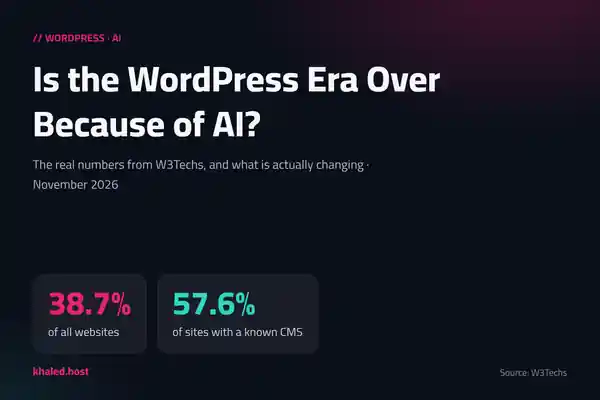
Is WordPress Dead? What the Numbers Say in 2026
W3Techs publishes each content management system’s share of the sites it tracks. According to its official overview on November 14, 2026, this is the picture:
| Platform | Share of all websites | Share of sites with a known CMS |
|---|---|---|
| WordPress | 38.7% | 57.6% |
| Shopify | 5.4% | 8.1% |
| Wix | 4.2% | 6.2% |
| Squarespace | 2.4% | 3.6% |
| Joomla | 1.0% | 1.6% |
| Drupal | 0.6% | 0.9% |
| No known CMS | 32.9% | Not listed |
What stands out is the history. In W3Techs’ yearly history, WordPress held 23.3% of websites on January 1, 2015, climbed to a peak of 43.6% on January 1, 2025, then 43.0% on January 1, 2026, and now sits at 38.7%. That is roughly ten straight years of growth, followed by the first clear decline.
The drop from 43.0% to 38.7% is 4.3 percentage points in under eleven months, while the share was almost flat between 2022 and 2026 (43.2% to 43.0%). So 2026 really is different from what came before, and it deserves an explanation.
Where Did the Share WordPress Lost Go?
If AI is pulling people away from WordPress, where would we see it in the numbers? This table compares platform shares between January 1 and November 14, 2026:
| Platform | Jan 1, 2026 | Nov 14, 2026 | Change |
|---|---|---|---|
| WordPress | 43.0% | 38.7% | −4.3 points |
| No known CMS | 28.6% | 32.9% | +4.3 points |
| Shopify | 5.0% | 5.4% | +0.4 points |
| Wix | 4.2% | 4.2% | No change |
| Squarespace | 2.4% | 2.4% | No change |
An honest reading gives three points:
- The known competitors did not take the share. Wix and Squarespace did not move, and Shopify gained just 0.4 points.
- The share moved to “no known CMS”, which rose 4.3 points, almost exactly what WordPress lost.
- W3Techs does not define that group or explain it. It could be hand-coded sites, sites generated with AI tools, sites W3Techs can no longer fingerprint, or a change in how it measures.
My personal view is that part of this shift is tied to AI site generators, but I file it under hypothesis, not fact until an independent source publishes an analysis linking the two.
Is WordPress Dead? Why the WordPress Era Is Not Over
Losing 4.3 points is not a collapse. Here are three reasons I say the WordPress era is not over yet:
- The lead is still wide. 57.6% against Shopify’s 8.1%. No platform is anywhere near that gap.
- The platform keeps renewing itself. According to W3Techs, 69.5% of WordPress sites run version 7, and 7.2 ships soon. I covered what is in it in WordPress 7.2: everything new and the release date.
- You own your site. The content, database and plugins sit on your hosting, unlike closed platforms that control pricing and limits. That matters if you depend on your site for Google visibility and selling services.
What AI Actually Changes
Is WordPress dead for small brochure sites, then? Not dead, but under pressure. Here I set the numbers aside and give my opinion from hands-on work. I see AI pressing on WordPress from three directions:
- Simple brochure sites. A single simple page for a small business can now be generated in minutes by an AI tool. This customer used to buy a cheap WordPress site, and is the most affected.
- Routine work. Installing a theme, setting up pages, writing SEO descriptions for dozens of pages: tasks a developer billed hours for, which an AI agent now does under supervision.
- Expectations before execution. Clients now arrive having tried something themselves, with a picture in mind. The value of the “first draft” drops and the value of quality execution rises.
What AI does not solve is what makes real sites hard: speed, security, technical SEO, integrations and maintaining a site that runs for years. Those are exactly the problems a mature WordPress setup knows how to solve.
AI Works Through WordPress, Not Instead of It
Is WordPress dead when AI agents connect straight to it? In my view the opposite: WordPress itself is becoming a platform that AI connects to. The MCP protocol and the Abilities API let an agent like Claude read your site and run specific tasks with permissions you define.
This isn’t theory for me: I run this site through MCP and have written up the experience step by step. To try it, start with the Easy MCP AI guide for connecting WordPress to AI tools, then Elementor MCP for building pages by command, then my guide to making WordPress AI-agent-ready.
And if your site is built with Elementor 4, read what is still missing from Elementor Atomic before you update.
Who Gains and Who Loses?
This is my own assessment, not a published statistic:
| Project type | Expected impact | Why |
|---|---|---|
| Simple brochure page for a small business | High pressure | An AI tool can generate it in minutes |
| Company site that depends on SEO | Limited | Needs speed, content structure, technical SEO and full ownership |
| Online store | Limited | Integrations, payments and shipping are more complex than quick generation |
| Developer selling routine tasks by the hour | High pressure | An AI agent does them faster |
| Developer fluent in AI and WordPress | Opportunity | Delivers faster, cheaper results at higher quality |
What to Do Now
Is WordPress dead for your own project? Use this checklist before deciding anything:
- If you own a site: don’t migrate because of a scary headline. Review its speed, security and SEO, then ask your developer how to use AI to cut costs.
- If your site is slow: your problem is older than AI. See why a WordPress site is slow and how to fix it.
- If you are a developer: learn MCP and the Abilities API now. Whoever connects WordPress to AI safely will be in a stronger position than whoever ignores it.
- If you are starting a project: choose the platform where you own your content and data, and add AI to it instead of giving up ownership.
Is WordPress Dead? WordPress and AI FAQ
Is WordPress dead?
No. According to W3Techs on November 14, 2026, WordPress runs 38.7% of all websites and 57.6% of sites with a known CMS, about seven times Shopify in second place (8.1%). But its share fell from 43.0% at the start of 2026, and that decline is real.
Is AI the reason WordPress is losing share?
There is no published evidence that it is. W3Techs shows WordPress down and the ‘no known CMS’ group up by a similar amount (about 4.3 points each), but it does not explain why. Sites hand-coded or generated with AI tools plausibly sit in that group, yet that is a hypothesis, not a proven result.
Is learning WordPress still worth it in 2026?
Yes, as long as you learn it as a platform that connects to AI rather than a set of dashboard clicks. Demand for someone who runs a real site securely, fast and with solid SEO has not gone away, while the value of routine tasks an AI agent can do is falling.
Can AI build a complete WordPress site?
It can build a large part of one through MCP and the Abilities API, from creating pages to tuning SEO. But decisions about identity, offers, permissions and what gets published still need a human reviewing. That is why I treat AI as an accelerator, not a replacement.
Which platform is gaining the most from WordPress?
According to W3Techs, Shopify rose from 5.0% to 5.4% of all websites in 2026, while Wix and Squarespace did not move (4.2% and 2.4%). The biggest jump was in ‘no known CMS’, from 28.6% to 32.9%.
Should I start a new site on WordPress or an AI builder?
For a test or a temporary one-page site, a quick AI generator is enough. For a site you depend on for Google visibility and selling services, pick a platform where you own your content and data and that connects to AI. WordPress is one of the strongest options there.
Conclusion
So, is WordPress dead? No. The numbers say the WordPress era has entered a new phase: the lead remains, but easy growth has stopped and the share has begun to fall. They do not say AI is the cause, because nobody has shown that yet. My position is clear: whoever treats AI as a tool inside WordPress will win, and whoever sells what AI can make in minutes will lose.
If your real question is whether to build on WordPress or pay for custom code, WordPress vs custom coding compares cost, security and when each one wins.
Want a fast site, ready for SEO and for working with AI? See my landing page design and Figma to WordPress services, or start your project directly on WhatsApp.
Sources: W3Techs: Content management systems · W3Techs: yearly usage history · W3Techs: WordPress. All figures as of November 14, 2026.